Car Key Services
High-Security and Laser-Cut Car Keys
What laser-cut and sidewinder car keys are, how to tell if you have one, and why most places that cut ordinary keys can’t cut yours.
We come to you
Driveway, lot or roadside
Call or text
Same number, either way
Ownership checked
ID and paperwork, every job
Keys, fobs & remotes
Every kind, one call
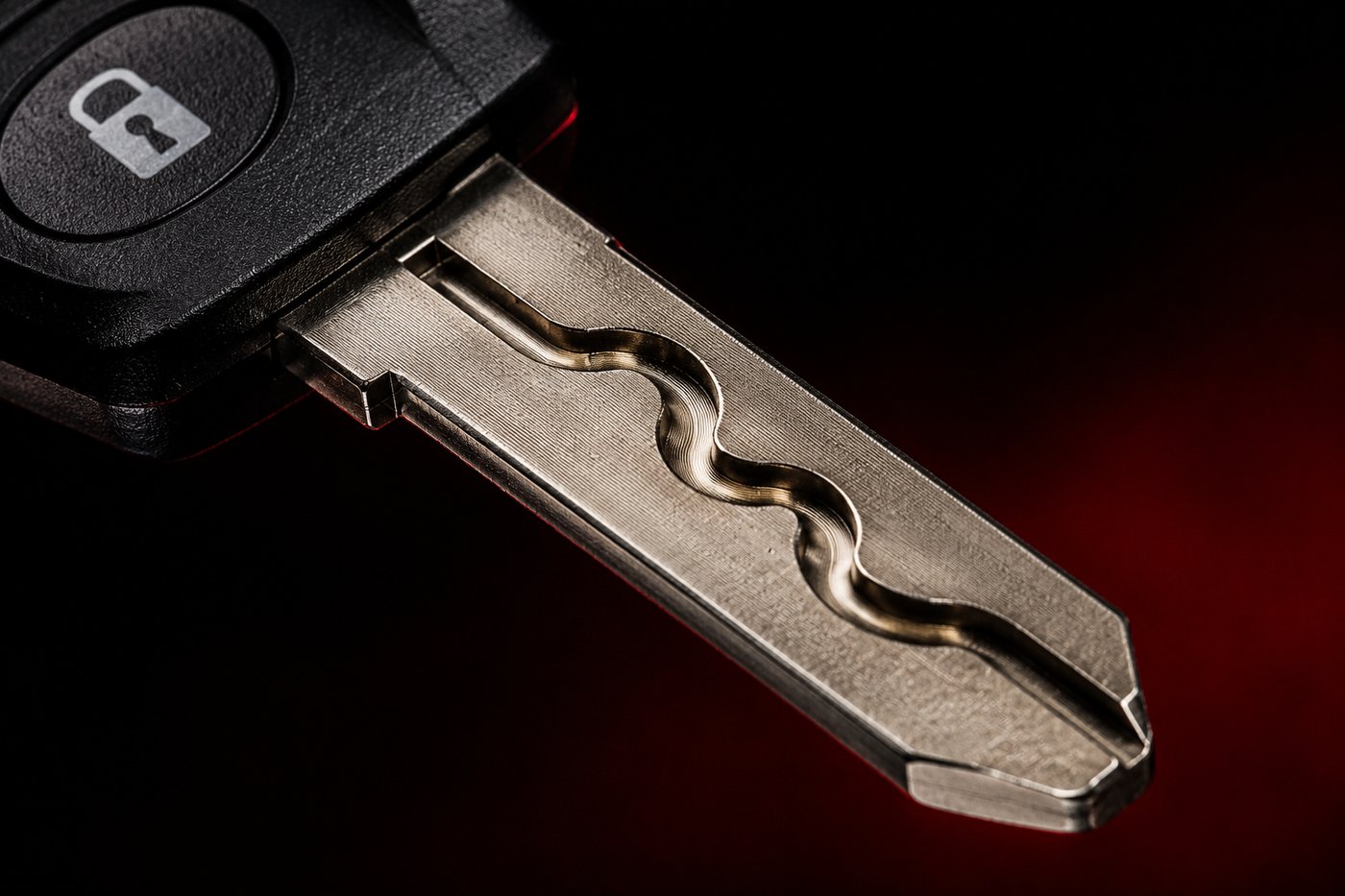
A laser-cut car key has a groove milled along the face of the blade instead of teeth cut into the edge. It’s also called a sidewinder or internal-cut key. Producing one needs a milling machine rather than a standard key duplicator, which is why most places that copy ordinary keys can’t cut it.
Same key, three names
If you’ve been told your key is high-security, laser-cut, sidewinder, or internal-cut, those are describing the same thing from different angles.
Laser-cut refers to how it’s made — a machine mills a track into the blade. The name is slightly misleading, since it’s a cutting wheel rather than an actual laser.
Sidewinder describes what the result looks like: a winding groove running down the face, like a snake’s track.
High-security describes what it achieves. The design is harder to pick, harder to force, and considerably harder to duplicate than a traditional edge-cut key.
Internal cut is the technical description — the cuts are on the flat of the blade rather than its edge.
One thing worth separating: this is all about the blade. Whether your key also has a transponder chip is a completely different question, covered in our transponder keys guide. Plenty of keys have both. They’re independent features that happen to have arrived around the same time.
Do you have one?
You can settle this by looking at your key.
A traditional key has a jagged edge — teeth cut into one or both edges of the blade, and a flat face.
A laser-cut key has smooth edges and a wavy groove carved into the flat face, often on both sides. Run a fingernail along the face and you’ll feel the channel.
Two other tells. The blade is usually thicker and more substantial. And because the cuts are symmetrical, it typically goes into the lock either way up — no fumbling in the dark to find the right orientation.
Laser-cut keys have been increasingly common across many manufacturers since roughly the 2000s. If your car is newer and the key feels chunky with a smooth edge, it’s very likely one.
Need a key sorted? Call or text — same number.
Why most places can’t cut them
This is the part that explains every frustrating conversation people have about these keys, and it isn’t a policy decision.
A traditional key duplicator works by tracing. A stylus follows the edge of your original while a cutting wheel reproduces the same profile on a blank. It’s an elegant mechanical copy, and it only works on edge cuts.
A laser-cut key has nothing on the edge to trace. The information is a groove milled into the face at varying depths, which requires a machine that can move a cutter in more than one axis — a milling machine, computer-controlled, working from either a decoded key or manufacturer data.
So when a hardware store says it can’t cut your key, that’s usually accurate rather than unhelpful. The machine on their counter physically cannot produce that shape. It isn’t a question of willingness or of your key being special.
Our guide to what each option can actually do covers which chains have what.
That’s also why a laser-cut key often can’t be copied from your existing key alone. A worn original produces a worn copy, and worn laser cuts are less forgiving than worn edge cuts. Cutting to the vehicle’s original specification usually gives a better result than copying a key that’s been in a pocket for eight years.
Keys that can’t be copied at all
Four questions come up constantly here, and the honest answers are less dramatic than people expect.
“Which keys cannot be copied?” Practically, keys nobody has the right machine or the right blank for. That’s less about prohibition and more about equipment and supply.
“What keys are illegal to copy?” This is widely misunderstood. A “Do Not Duplicate” stamp is generally a request from whoever issued the key, not a law — it’s a shop policy that reputable places honour rather than a criminal restriction. We aren’t lawyers and this isn’t legal advice; if it matters to your situation, ask someone who is.
Restricted keyways are a real thing, mostly in commercial and institutional buildings. They’re protected commercially — patented profiles, blanks sold only to authorised dealers — rather than criminally. The control is over supply.
For car keys specifically, the meaningful restriction is access to manufacturer data. Key codes and security files aren’t published; they’re released through a vetted registry to people who’ve been background-checked and can prove who they’re working for. That’s why any legitimate locksmith asks for your registration and ID. The key fob replacement guide covers how that system works.
So: not illegal, but genuinely controlled. Which is the point.
Locksmith or dealership?
Both can do it. The differences are practical.
A dealership has manufacturer data and equipment for its own brand. The vehicle usually has to reach them, which matters if it can’t be driven.
An automotive locksmith with the right milling equipment covers multiple manufacturers and comes to the vehicle. The relevant question isn’t the trade, it’s whether the individual shop has the machine and the data access for your make.
That’s a fair question to ask anyone, including us. A shop without the right equipment for your vehicle should tell you so rather than take the booking.
On cost, we won’t quote a comparison because it depends on the make, the key type, whether you have a working original, and whether towing is involved. What determines car key replacement cost covers what actually moves it.
What we’ll need from you
- Year, make and model
- Whether you have a working key, and all of them at the appointment
- What the key looks like — jagged edge, or a groove down the face
- Whether it has buttons or a chip
- Where the vehicle is, and whether it can be driven
- Proof of ownership — registration or title, and matching photo ID
Laser-cut and high-security keys are cut on site, then programmed at the vehicle if they carry a chip. The exceptions are the small group of late-model vehicles that need the dealer, listed on the key fob replacement page.
How quickly we get there. Around Poughkeepsie most calls are reached within 30–45 minutes, the rest of Dutchess within about an hour, and Putnam, Ulster and Orange in roughly an hour, longer at rush hour or with bridge traffic. You get a real arrival time on the phone before we set off.
Where we work
Based in Poughkeepsie, covering Dutchess, Putnam, Ulster and Orange counties, plus Westchester, Rockland and Columbia. Full coverage on the service areas page.
If your car uses a laser-cut key and you only have one, that’s the situation worth acting on early. These are the keys where having no working original makes the biggest difference to the job.
Frequently asked questions
What is a laser cut key?
A key with a groove milled along the face of the blade rather than teeth cut into the edge. It requires a milling machine to produce, and it’s harder to pick or duplicate than a traditional key.
What is a sidewinder key?
The same thing as a laser-cut key. The name describes the winding groove down the face of the blade.
What is a high security key?
A general term for keys designed to resist picking and unauthorised duplication. On cars that usually means a laser-cut blade, sometimes combined with a transponder chip.
Can you copy a laser-cut key?
Yes, with the right equipment — a milling machine rather than a standard duplicator. Cutting to the vehicle’s original specification usually produces a better result than copying a worn original.
Which keys cannot be copied?
Practically, keys nobody has the machine or the blank for. For car keys the real limit is access to manufacturer data, which is released through a vetted registry rather than published.
What keys are illegal to copy?
"Do Not Duplicate" is generally a request rather than a law — a policy reputable shops honour. Restricted keyways are controlled commercially through patents and blank supply. We aren’t lawyers; ask one if it matters to your situation.
Who can laser-cut car keys?
Anyone with a milling machine and the right data access — typically dealerships and automotive locksmiths equipped for it. Most hardware stores and kiosks can’t, because a standard duplicator physically can’t produce the shape.
Can I get a new key with my VIN number?
The VIN identifies which key information applies to your vehicle, but the data is released through a vetted registry, not published. Any legitimate locksmith will verify ownership before requesting it.
Other car key services
Locked out or lost your key? Call The Fobfather